
Is Morocco Safe for Americans? An Honest 2026 Guide from a Luxury Travel Agency on the Ground
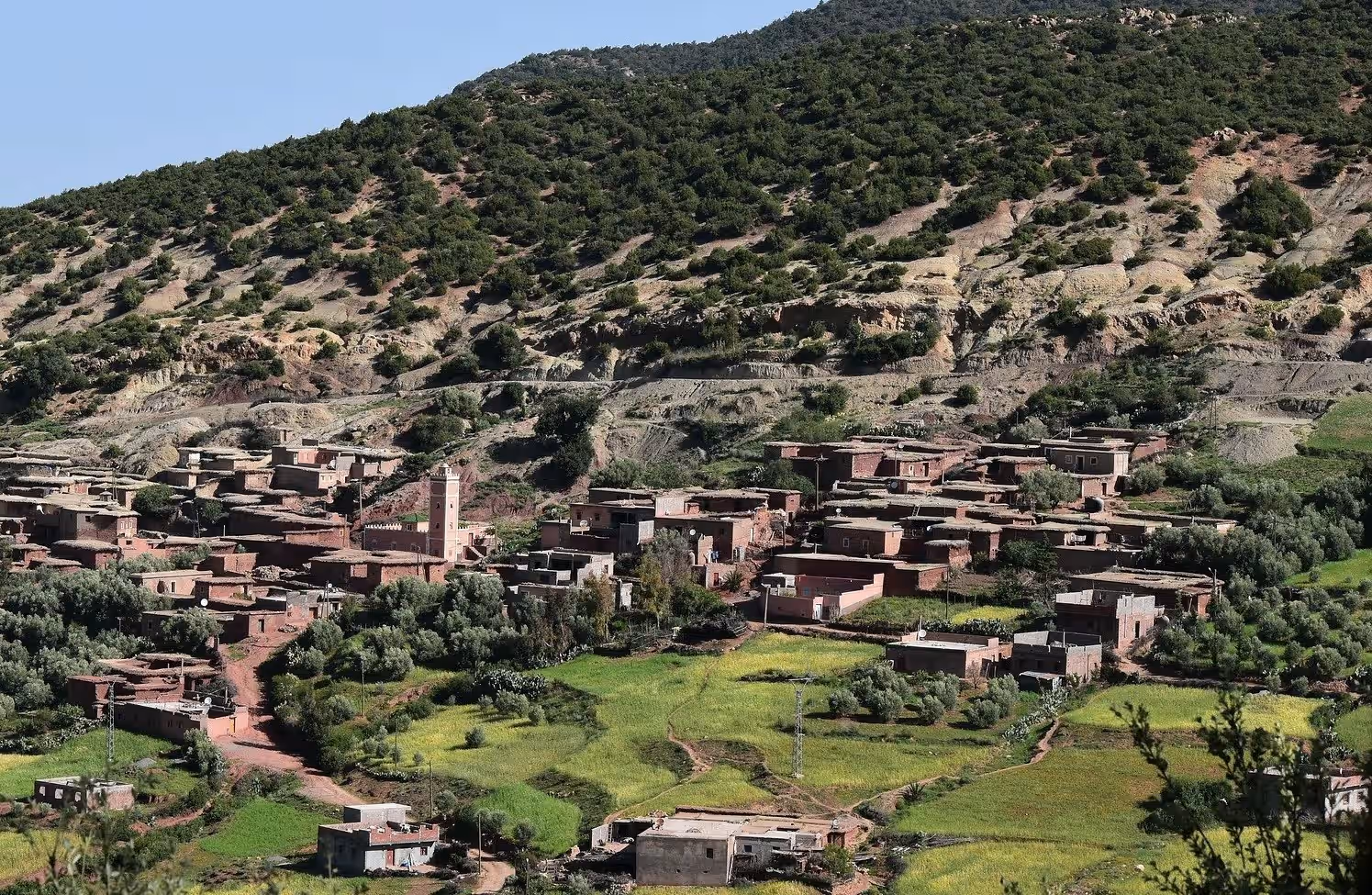
If you are an American planning a trip to Morocco, you have almost certainly typed the same question into Google as half our incoming guests do: is Morocco safe for Americans? It is a fair question. We are a luxury travel agency based in Morocco itself, building private journeys for travelers from New York, Los Angeles, Chicago, Dallas, and Atlanta, and we have seen the question from every angle.
The short answer is yes.
Morocco is safe for American travelers, and has been for a long time. The longer answer, the one that actually helps you plan, is what this page is for.
Safety Snapshot for American Travelers
|
Topic |
Reality on the Ground |
|
Overall safety |
Generally safe, one of the safest destinations in North Africa |
|
Violent crime |
Rare, especially against tourists |
|
Petty theft & pickpocketing |
Possible in crowded medinas and transportation hubs |
|
Terrorism risk |
Low, monitored by Moroccan security forces |
|
Female travel |
Generally safe, with normal precautions |
|
Solo travel |
Comfortable, especially with private transport |
|
Taxi safety |
Petit Taxi, Grand Taxi, Careem, InDrive widely used |
|
Tap water |
Stick to bottled water |
|
Medical care |
Excellent private clinics in Casablanca, Rabat, Marrakech |
Is Morocco Safe for Americans? The Honest Long Answer
The neighbourhoods most travellers spend time in are, by some margin, the most secure parts of the city. The Anfa hill and the surrounding upmarket residential districts are quiet and well-patrolled, with the embassies, private hospitals and the better hotels clustered nearby. The Corniche and the Ain Diab seafront, where Casablanca comes alive on weekends, sees a heavy concentration of restaurants, beach clubs and families well into the evening, and feels comfortable even after dark.
The area surrounding the Hassan II Mosque is calm, beautifully maintained, and visited by many travelers every day. The mosque itself, one of the few in the country open to non-Muslim visitors on guided tours, is a model of how Morocco organises its heritage sites: orderly, dignified, with a steady police presence in the precinct. Downtown, the art deco core around Place Mohammed V and the Boulevard Mohammed V can be walked freely during the day, with the same situational alertness you would bring to central Madrid or Lisbon.
Where Ordinary Caution Pays Off
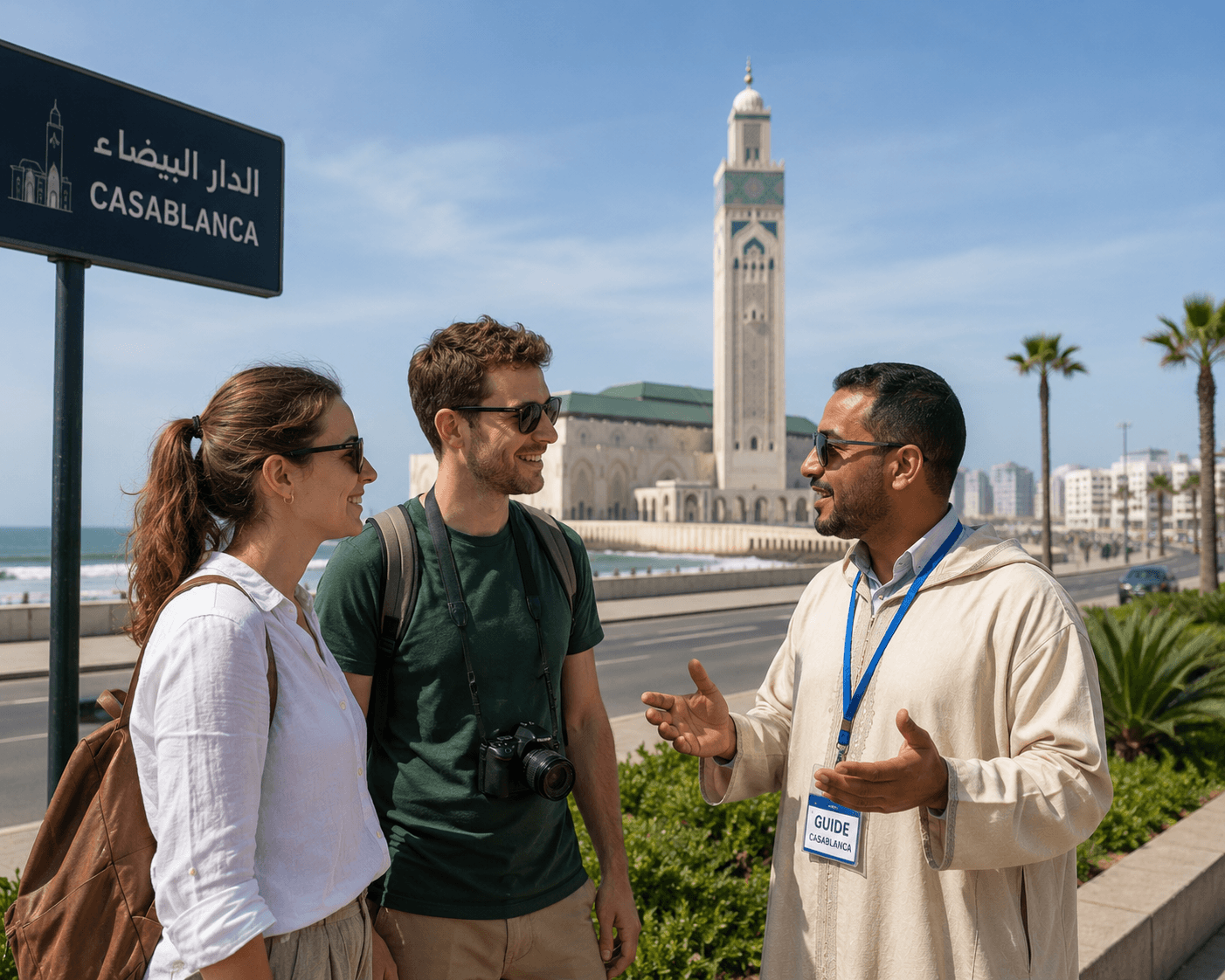
Two areas deserve a little more attention. The Old Medina of Casablanca, smaller and less polished than its counterparts in Fez or Marrakech, is fine to visit by day, ideally with a local guide who knows the lanes, but is not a place to wander alone at night. The area immediately around the Casa-Port train station is busy and useful, but it is a transport hub, and the usual cautions about phones, bags and distraction apply.
Some of the peripheral neighbourhoods of greater Casablanca, the working-class districts well away from any tourist itinerary, are not unsafe in any dramatic sense, but they offer little to a visitor and are best skipped. Our suggested itineraries simply do not pass through them; the city’s rewards are concentrated in a handful of districts and there is no need to go further afield.
The Honest Picture on Crime
The crime that affects visitors in Casablanca is overwhelmingly opportunistic. A phone lifted from a café table while you take a photograph of your coffee. A bag snatched from an unguarded chair. A wallet teased out of a back pocket on the tramway. The countermeasures are familiar to any seasoned traveller: a phone never left on a table, a bag worn across the body, valuables kept in your hotel safe, and a mild vigilance in crowded settings.
Violent crime against tourists is rare. Casablanca does not have the gun culture of some American cities, the organised street crime of certain European capitals, or the kidnapping risks of some destinations elsewhere on the continent. The Moroccan state takes the security of its largest economic centre seriously, and the visible police presence in the central districts is a reflection of that priority. The country’s broader safety performance, in international comparisons of homicide and tourist crime rates, places Morocco among the more secure destinations in the region.
A common reflex in any city is to assume the worst about strangers offering help. In Casablanca, that reflex is largely unnecessary, most people who approach a visibly lost visitor are simply being helpful. The handful who are not become obvious within a sentence or two; a polite decline ends the encounter.
Women Travellers in Casablanca
Casablanca is the most relaxed Moroccan city for female travelers, and this is not a small distinction. Women here dress with extraordinary variety, from the most traditional djellaba to entirely Western office wear and beachwear at the Ain Diab clubs. The cosmopolitan tone of the city means a visitor in jeans and a t-shirt blends in without effort, particularly in the Corniche, Anfa, and the central business district.
The unwanted attention some women report elsewhere in Morocco is noticeably less prevalent here, though not entirely absent. The Old Medina and the busier downtown streets at lunch hour can still produce the occasional comment or persistent vendor. The standard response, a confident pace, sunglasses, no eye contact with strangers calling out, deflects nearly all of it. Solo women dining alone, walking the Corniche, working from a café, are an everyday sight in Casablanca; they fit the city’s working rhythm rather than disrupting it.
For evening plans, the same logic applies as in any large city: stay within established venues, return by pre-booked car rather than hailing one on the street late at night, and let your hotel or operator advise on the right neighbourhoods. Our honeymoon and romantic travel and family tours pages outline how we design journeys with these realities in mind.
Moving Through the City
Getting around Casablanca is straightforward, and the choices a visitor makes here shape both safety and comfort. The petits taxis (small, red, metered) are inexpensive, plentiful, and the local default; insist on the meter and you will rarely have a problem. The Casablanca tramway, which now stretches across much of the city, is modern, clean and useful for confident travellers, though tourists rarely need it. https://en.wikipedia.org/wiki/Hassan_II_Mosque, larger and shared, cover routes between the city and its outskirts and are less suited to visitors.
What we recommend, and what we provide for our own travellers, is a pre-arranged private car. The driver who collects you at Mohammed V International Airport is the same driver who knows your luggage and your hotel, who waits if your flight is delayed, who speaks your language. The peace of mind this introduces after a long international flight is considerable, and it carries through the rest of your time in the city.
For drivers planning to rent a car, Casablanca traffic is busy and assertive, and we generally suggest leaving the wheel to a local. The road safety picture elsewhere in Morocco is more nuanced, and our broader Morocco travel tips page covers it in detail.
Evening, Nightlife and the Atlantic Coast
The nightlife in Casablanca is, by a wide margin, the most developed in Morocco. Ain Diab and the Corniche are lined with beach clubs, lounges, and restaurants that stay open well past midnight. Cocktail bars in the upscale hotels function as informal meeting points for the city’s professionals; the rooftop scene has grown considerably in recent years.
By regional standards, the city is relatively liberal, and a night out resembles one in any Mediterranean capital. The same precautions apply as anywhere with a real night economy: stay with reputable venues, watch your drink, organise your return transport in advance, and avoid wandering on foot through unfamiliar streets late. The Corniche itself, with its constant flow of people until late, is among the safest evening environments in the country.
Practical Notes Before You Arrive
A handful of details make the first hours in the city easier. Mohammed V International Airport sits roughly thirty kilometres south of central Casablanca; transfer time is forty-five minutes to an hour depending on traffic. Pre-arranged pickup is the comfortable choice; the taxi rank exists but involves negotiation that few travellers want after a long flight.
Travel insurance covering medical treatment, repatriation and any planned activities is essential, and we ask all our guests to arrange it before arrival.
On the travel health front, no vaccinations are required from most countries, though hepatitis A and B and tetanus are sometimes recommended depending on your wider Moroccan itinerary. Bottled water is the easy default; tap water in modern Casablanca hotels is chlorinated and generally fine, but bottled is simpler and inexpensive. Street food is part of the city’s pleasure, particularly the fresh seafood near the port; choose busy stalls with high turnover and you will eat well.
A few words of Arabic or French go a long way. Bonjour, merci, s’il vous plaît will carry you through almost any interaction in the city, where French is the lingua franca of business and daily life. English is widely spoken in hotels, larger restaurants, and the tourism industry, less so in petit taxis and corner shops.
What Sets a Private Arrival Apart
Most of the safety concerns raised by independent travellers in Casablanca are not about danger; they are about friction. A confused arrival at the airport, an argument with a taxi driver, a hotel in the wrong neighbourhood, an evening cut short by uncertainty about how to get back. None of this is dangerous. All of it is exhausting.
A private journey removes these layers entirely. Your driver holds your name at arrivals. Your hotel has been chosen for its district, its security and its hospitality. Your evening plans come with a return car arranged before you leave the table. A 24-hour local contact knows your itinerary by heart. The question of is Casablanca safe, in this context, becomes academic; the answer is yes, and you spend your attention on the city rather than on logistics.
This is the quiet difference a real operator makes. Our why Sun Trails page outlines our approach in more detail, and our Casablanca travel notes explore why the city deserves more attention than it typically receives in standard Moroccan itineraries.
Frequently Asked Questions
Is Casablanca safe for American travellers?
Yes. American travelers are well served in Casablanca, with widespread English in hotels and restaurants, a US consulate in the city, and established international standards in the better districts. Standard travel precautions apply.
Is Casablanca safe at night?
The Corniche, Ain Diab, Anfa and the central business district are generally safe at night with normal urban awareness. Avoid walking alone through quiet or poorly lit streets late, and arrange return transport in advance from any evening out.
How does Casablanca compare to Marrakech for safety?
Both cities are generally safe. Casablanca feels more European in its rhythm, with fewer of the high-pressure encounters tourists sometimes experience in Marrakech‘s souks. The textures differ; the underlying safety levels are broadly comparable.
Is the Old Medina in Casablanca worth visiting, and is it safe?
The Old Medina is smaller and less spectacular than those in Fez or Marrakech, but worth an hour with a local guide. It is safe by day; we do not suggest visiting alone after dark.
Do female travellers need to dress conservatively?
Less so than elsewhere in Morocco. The Corniche, Anfa and upmarket neighbourhoods are essentially Western in dress code. In the Old Medina and traditional districts, modest dress (shoulders and knees covered) is appreciated.
Is it safe to drive in Casablanca?
Driving in Casablanca is feasible but demanding; traffic is dense and assertive. Most visitors are better served by petits taxis or pre-arranged private cars. We strongly recommend you avoid driving at night on roads outside the city.
Is the airport area safe?
Mohammed V International Airport is modern, well-policed and entirely safe. Pre-arranged transfers are strongly recommended over the taxi rank, particularly for late arrivals.
A Comfortable Beginning to Your Morocco Journey
Many travellers underestimate Casablanca, treating it as an arrival point to clear quickly on the way to Marrakech or Fez. This is, in our view, a quiet error. The city repays a thoughtful visit: an evening on the Corniche, an hour inside the Hassan II Mosque, a slow lunch in the Habous Quarter, the discovery that Morocco’s modern face is as compelling as its ancient one.
Casablanca is ready to welcome you. We will take care of the rest.