Kitesurfing Morocco: Chase Perfect Wind Along Africa’s Atlantic Coast
Kitesurfing in Morocco puts you where the trade winds blow reliably, where flat-water lagoons stretch for kilometers, and where Atlantic waves offer kite-powered rides you’ll remember forever. From the otherworldly lagoon at Dakhla to the historic charm of Essaouira, Morocco has quietly become one of the world’s essential kitesurfing destinations – consistent wind, diverse conditions, affordable living, and a culture that makes every session feel like adventure.
Update 2026: Morocco’s kitesurfing infrastructure continues expanding, with new schools, camps, and facilities joining established operations. The wind keeps blowing; the riders keep coming. Here’s everything you need to know about kitesurfing Africa’s premier Atlantic coast.
Why Morocco for Kitesurfing?
The global kite community has discovered what wind chasers have known for years – Morocco delivers.
Legendary wind consistency: The alizé trade winds blow reliably along Morocco’s Atlantic coast, especially from April through September. While European spots suffer through windless summers, Morocco’s coast lights up with side-offshore conditions that create perfect kiting.
Diverse conditions: Flat-water lagoons for freestyle and progression. Ocean swells for wave riding. Choppy bays for all-around sessions. Whatever your style, Morocco has terrain to match.
Extended season: While many destinations offer narrow kite windows, Morocco provides rideable conditions for much of the year. Dakhla operates nearly year-round; Essaouira peaks in summer but delivers wind in shoulder seasons too.
Affordability: Accommodation, food, lessons, and equipment cost a fraction of Caribbean or European prices. You can kite for weeks on budgets that would last days elsewhere.
The adventure factor: Morocco isn’t a one-dimensional wind destination. Between sessions, you’re in Africa – exploring medinas, crossing deserts, eating extraordinary food, experiencing a culture vastly different from home.
Warm hospitality: Moroccan warmth extends to the kite community. Local riders, camp operators, and instructors welcome visitors genuinely – the vibe is inclusive rather than exclusive.
Morocco’s Kitesurfing Destinations
Dakhla – The World-Class Lagoon
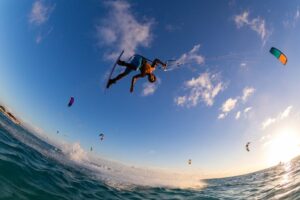
If you’ve seen photos of perfect flat water stretching to the horizon, kites dotting impossibly blue sky, riders throwing unhooked tricks without a ripple – you’ve probably seen Dakhla.
This remote lagoon in Morocco’s deep south (technically in the Western Sahara region) has earned its reputation as one of the world’s premier kitesurfing destinations. The statistics speak: wind blows 300+ days per year, water stays flat in the protected lagoon, and conditions suit everyone from beginners to professionals.
Why Dakhla is special: The 40-kilometer lagoon creates butter-flat water regardless of wind strength. You can unhook without fear of chop. Beginners learn in waist-deep shallows. Freestyle riders have a playground with no limits. The consistency is remarkable – if you book a week, you’ll kite almost every day.
The conditions: Side-offshore winds (typically 18-30 knots), flat lagoon water, year-round operation with peak season April-October. Water temperature stays warm; full wetsuits rarely needed.
The experience: Remote, otherworldly, focused. Dakhla exists primarily for kitesurfing (and increasingly fishing). You come here to ride, eat, sleep, repeat. The landscape is stark desert meeting turquoise lagoon – beautiful in its minimalism.
Who should go: Everyone from beginners (perfect learning conditions) to advanced freestylers (flat water for big tricks) to wave riders (ocean access available). The lagoon particularly suits those wanting maximum progression in minimum time.
Essaouira – Wind City Culture
Essaouira offers what Dakhla can’t – a historic medina, artistic atmosphere, and complete destination experience wrapped around excellent kiting conditions.
The same alizé winds that challenge surfers create paradise for kitesurfers. From April through September, Essaouira’s beaches light up with kites, the wind blowing reliably day after day.
Why Essaouira is special: You’re not just kitesurfing – you’re staying in a UNESCO World Heritage town with genuine character. Morning sessions, afternoon medina exploration, evening seafood on the port. The balance between sport and culture works beautifully.
The conditions: Side-onshore winds (15-25 knots typical), beach break waves, some flat-water spots. Best April-September; wind appears year-round but less consistently in winter.
The experience: Bohemian, artistic, culturally rich. Essaouira attracts kitesurfers who want more than just wind. The town’s galleries, Gnawa music, and food scene create a complete destination.
Who should go: Intermediate to advanced riders comfortable with waves and current. Beginners can learn but conditions are less forgiving than Dakhla. Those wanting surf + kite combination, or traveling with non-kiting partners who need activities.
Land of the Setting Sun
Marrakech to Fez via Sahara
Salt and all that Glitters
Moulay Bouzerktoun – Competition Caliber
North of Essaouira, Moulay Bouzerktoun hosts international kitesurfing competitions for good reason – the wind is fierce and reliable.
Why Moulay is special: Strong, consistent wind and challenging conditions attract serious riders. The annual competitions draw professionals from around the world.
The conditions: Strong winds (often 20-35 knots), wave and flat sections, challenging currents. Best May-September.
Who should go: Intermediate to advanced riders seeking powerful conditions and competition-level venues.
Dakhla Alternatives – Lassarga and Speed Spots
Within the greater Dakhla area, multiple spots cater to different styles:
Lassarga: Slightly north of main Dakhla, offering different wind angles and uncrowded sessions.
Speed strip: Dedicated flat-water zones for speed attempts and record chasing.
Ocean spots: Wave riding on the Atlantic side when flat-water freestyle loses its appeal.
Other Locations
Morocco’s extensive coastline offers additional possibilities:
Tarifa day trips: While technically Spain, the short ferry from Tangier puts you at one of Europe’s kitesurfing capitals.
Agadir area: Some kite-friendly beaches with developing infrastructure.
Oualidia: Lagoon with occasional kite activity, though less developed than Dakhla.
Best Time for Kitesurfing in Morocco
Understanding Moroccan Wind Patterns
Morocco’s kitesurfing season follows the alizé trade winds – consistent northerly/northeasterly winds that blow along the Atlantic coast. These winds strengthen in late spring, peak in summer, and diminish in autumn.
Dakhla: Year-Round Destination
Dakhla operates differently from northern Morocco – its position further south means wind blows almost continuously:
Peak season (April-October): Most consistent wind, strongest conditions, busiest camps
Shoulder season (November-March): Still excellent wind, slightly less consistent, fewer crowds
Year-round average: 300+ wind days annually
Water temperature: Warm year-round (20-24°C). Shorty or boardshorts sufficient most of the time.
Air temperature: Hot in summer (35°C+), pleasant in winter (20-25°C).
Essaouira: Seasonal Peak
Essaouira’s wind follows a more pronounced seasonal pattern:
Peak season (May-September): Reliable daily wind, strongest conditions
Shoulder season (April, October): Good wind probability, less intense
Off-season (November-March): Wind appears but inconsistently; better for surfing
Water temperature: 16-22°C depending on season. Wetsuit needed except peak summer.
Monthly Overview
Month | Dakhla | Essaouira | Notes |
January | Good | Inconsistent | Dakhla calmer; Essaouira surf season |
February | Good | Inconsistent | Similar to January |
March | Excellent | Building | Season starts |
April | Excellent | Good | Ideal Dakhla; Essaouira warming up |
May | Peak | Excellent | Both destinations firing |
June | Peak | Peak | Prime time everywhere |
July | Peak | Peak | Hottest, busiest |
August | Peak | Peak | Strong wind, crowded |
September | Excellent | Excellent | Crowds thin, conditions remain |
October | Excellent | Fading | Dakhla still strong |
November | Good | Inconsistent | Shoulder begins |
December | Good | Inconsistent | Winter pattern |
Kitesurfing by Skill Level
Beginners: Learning to Kite in Morocco
Morocco offers excellent learning conditions – particularly Dakhla’s flat lagoon with consistent wind.
Why learn in Morocco:
Dakhla’s shallow, flat lagoon is among the world’s best learning environments
Consistent wind means lessons rarely cancel
Affordable instruction compared to Europe or Americas
Warm water reduces cold-related fatigue
Where to learn:
Dakhla: Ideal – flat water, consistent wind, dedicated beginner zones
Essaouira: Possible but more challenging due to waves and current
What to expect:
Typical progression: 9-15 hours to ride independently
Week-long camps provide best value and progression
Quality instruction matters – research schools before booking
Cost: €300-500 for a typical beginner course including equipment.
Intermediate: Progression Paradise
Morocco rewards intermediate riders with conditions that accelerate improvement.
Why Morocco accelerates progression:
Consistent wind means more time on the water
Diverse conditions build versatile skills
Flat water allows trick practice without wave complications
Affordable living extends trip length
Focus areas:
Dakhla: Freestyle, unhooking, jumps, transitions
Essaouira: Wave riding, powered surfing, choppy water skills
Both: Building overall confidence and style
Equipment considerations: Bring your own gear for reliability, or rent quality equipment at established camps.
Advanced: World-Class Conditions
Experienced riders find Morocco delivers at the highest level.
Why advanced riders choose Morocco:
Dakhla’s flat water allows the biggest tricks possible
Wave riding on the Atlantic matches global standards
Competition-level conditions at Moulay Bouzerktoun
Speed records have been set on Dakhla’s flat water
What’s available:
Freestyle coaching with professional riders
Wave clinics
Speed sailing opportunities
Competition participation
The Kite Camp Experience
What Camps Offer
Most Morocco kitesurfing visitors stay at dedicated kite camps, which typically include:
Standard packages:
Accommodation (rooms ranging from basic to boutique)
Breakfast and often dinner
Kite storage and rigging areas
Rescue boat coverage
Transport to kite spots
Community atmosphere
Optional additions:
Lessons and coaching
Equipment rental
Yoga and fitness
Massage and wellness
Excursions and tours
Dakhla Camps
Dakhla has developed significant kite infrastructure:
Camp styles range from:
Budget camps (€50-70/night): Basic rooms, good kite facilities
Mid-range camps (€80-120/night): Comfortable rooms, full amenities
Premium camps (€150-250/night): Boutique accommodation, premium service
What distinguishes camps: Location on the lagoon, boat coverage quality, food, and overall atmosphere vary significantly. Research reviews and ask specific questions before booking.
Essaouira Options
Essaouira offers more varied accommodation:
Kite-focused camps: Similar to Dakhla model, often located outside the medina near the beach
Independent approach: Stay in a medina riad, rent gear locally, kite independently – viable for experienced riders
Combination: Many visitors balance kite camps with nights in the historic medina for cultural experience
Equipment and Logistics
Bringing Your Own Gear
Most experienced kitesurfers bring personal equipment:
Airlines to Morocco: Royal Air Maroc, European carriers (Ryanair, Transavia, etc.), and others serve Morocco. Policies on kite gear vary – check baggage allowances and fees before booking.
What to bring:
Kites (2-3 sizes to cover wind range)
Board(s) – twin-tip and/or surfboard
Harness
Wetsuit (shorty for Dakhla, 3/2 for Essaouira)
Pump, repair kit, spare lines
Dakhla quiver suggestion: 9m and 12m cover most conditions; add 7m for strong wind days.
Essaouira quiver suggestion: 9m and 7m handle the typically stronger wind; 12m for lighter days.
Renting Equipment
Quality rental gear is available at major destinations:
Dakhla: Camps stock current-season equipment from major brands. Typical cost €40-60/day for complete setup.
Essaouira: Kite schools and shops rent equipment. Quality varies – inspect before renting.
Considerations: Rental makes sense for beginners, travelers testing conditions, or those avoiding airline hassle. Serious riders usually prefer personal equipment.
Lessons and Coaching
Beginner lessons: Widely available at both destinations. IKO-certified instruction recommended.
Coaching for progression: Advanced coaching available through camps and independent instructors – freestyle, wave riding, foiling.
Typical costs:
Beginner course: €300-500 (includes equipment)
Private coaching: €50-100/hour
Week-long progression camps: €800-1500 (varies with accommodation level)
Beyond Kitesurfing
Dakhla Activities
Dakhla is remote – activities beyond kiting are limited but include:
Fishing: World-class fishing opportunities
Surfing: Ocean breaks on the Atlantic side
Desert excursions: The surrounding Sahara offers stark beauty
Relaxation: The remoteness itself is the attraction
Essaouira Activities
Essaouira offers complete destination experience:
Medina exploration: UNESCO-listed historic town
Surfing: When wind drops, waves remain
Food scene: Fresh seafood, Moroccan cuisine
Art and culture: Galleries, Gnawa music, creative atmosphere
Day trips: Argan forest, Berber villages
Broader Morocco
For travelers with time, Morocco rewards exploration far beyond kite spots:
Marrakech: The Red City’s medina, gardens, and atmosphere – 2.5 hours from Essaouira.
Atlas Mountains: Trekking, Berber villages, dramatic landscapes – accessible from Marrakech or Essaouira.
Sahara Desert: Camel treks, luxury camps, star-filled nights – Morocco’s most dramatic landscape.
Every private Morocco tour we create is fully customizable – combining kitesurfing with cultural exploration creates journeys that transcend single-sport trips.
Combining Kite with Other Adventures
Kitesurfing Morocco integrates naturally with broader exploration:
Kite + Surf
Many riders pursue both sports:
Essaouira: Morning surf (before wind), afternoon kite – the daily rhythm works
Taghazout to Essaouira: Surf famous points, then drive north for wind
Dakhla: Ocean-side waves accessible when lagoon freestyle loses appeal
Kite + Culture
Morocco’s depth rewards those who look beyond the beach:
Essaouira + Marrakech: Wind city sessions combined with Red City immersion
Dakhla + Sahara: Extend south to the lagoon, explore desert en route
Kite + Adventure Sports
Morocco’s geography supports multi-sport trips:
Kitesurfing + sandboarding in the Sahara
Kitesurfing + mountain trekking in the Atlas
Kitesurfing + surfing along the coast
Practical Information
Getting There
To Dakhla:
Flights via Casablanca (Royal Air Maroc)
Some European charter flights in peak season
Long overland journey (not recommended for most travelers)
To Essaouira:
Fly to Marrakech, 2.5-hour transfer
Direct flights from some European cities (seasonal)
Fly to Agadir, 3-hour transfer north
Visas and Entry
Most nationalities receive 90-day visa-free entry to Morocco. Check current requirements for your passport.
Health and Safety
Water safety: Rescue boat coverage at reputable camps; still respect the ocean.
Sun exposure: Intense – reef-safe sunscreen, rashguard, hydration essential.
General safety: Morocco is generally safe; standard travel precautions apply.
Budget Expectations
Dakhla (per week, mid-range):
Accommodation + meals: €500-800
Equipment rental (if needed): €250-350
Flights: Variable (€300-600 from Europe)
Total: €1,000-1,800
Essaouira (per week, mid-range):
Accommodation: €300-500
Meals: €150-250
Equipment rental: €200-300
Flights: Variable (€100-400 from Europe)
Total: €750-1,450
What Our Guests Say
“Dakhla changed my kitesurfing. A week of flat water and consistent wind did more for my progression than a year at home. I landed my first back roll, my first kite loop, my first… everything. The lagoon is freakishly perfect – you have to experience it to believe it.” – Marcus, Germany
“We wanted kite but also Morocco. Essaouira delivered both. Sessions every afternoon when the wind came up, then exploring the medina, eating incredible food, listening to Gnawa music at night. The balance was perfect for us.” – Sophie, France
“I came for two weeks and stayed two months. Dakhla gets into your soul – the simplicity, the wind, the community of riders from everywhere. It’s not glamorous, but it’s pure kitesurfing paradise.” – Lucas, Brazil
“My wife doesn’t kite. Essaouira worked perfectly – I’d ride while she explored the medina and art galleries. We’d meet for lunch at the port, dinner in beautiful restaurants. Morocco lets couples with different interests thrive.” – James, UK
Start Planning Your Morocco Kite Adventure
Kitesurfing Morocco offers what wind-chasers dream of – reliable conditions, diverse terrain, affordable living, and a country that rewards exploration far beyond the beach.
Whether you want pure kite focus in Dakhla’s perfect lagoon, culture-rich sessions in Essaouira, or a journey combining wind with Morocco’s mountains and deserts, the options reward any approach.
We’ve been organizing luxury Morocco tours from Marrakech since 2009, including many that incorporate kitesurfing into broader adventures. Contact our team to discuss your plans. Tell us your skill level, when you’re traveling, and what matters beyond kiting. We’ll design a journey that maximizes your wind time and everything else Morocco offers.
The trade winds keep blowing. The lagoons keep shimmering. The adventure keeps calling.